As we race toward exascale computing and trillion-parameter AI models, the bottleneck isn't always the raw compute; it's the communication. How fast can GPUs talk to each other?
NVIDIA’s answer to this is the NVLink 5 and the NVLink Switch, unveiled at Computex 2025.
The NVLink 5 is NVIDIA’s fifth-generation interconnect, promising unprecedented GPU-to-GPU communication. A single Blackwell GPU supports 18 NVLink connections at 100GB/s each, totaling 1.8TB/s, double the previous generation and 14x faster than PCIe Gen5.
What this means for AI models like GPT-4 or Llama 3.1 is that they can run smoother because GPUs share data almost instantly, keeping Tensor Cores busy and performance maxed out.
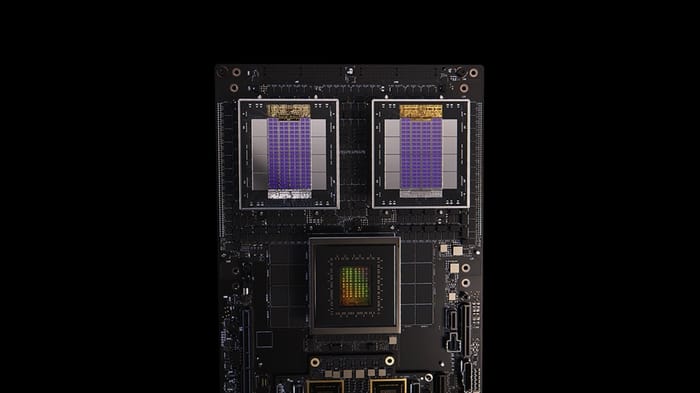
But NVIDIA didn’t stop there. The NVLink Switch lets GPUs across multiple servers talk just as fast, linking up to 576 GPUs at full speed. Systems like the GB300 NVL72 leverage this, unifying 72 Blackwell GPUs into a single 1.4 exaFLOP AI powerhouse with 130TB/s of bandwidth across the rack. Inside the switch, SHARP (Scalable Hierarchical Aggregation and Reduction Protocol) engines speed up data crunching right in the network, making huge AI clusters ready for real-world use.
But this year, the most unexpected part of NVIDIA’s NVLink unveiling wasn‘t just the tech, but the ecosystem as well. With NVLink Fusion unveiled alongside, NVIDIA is opening its gates. For the first time, they’re letting other companies integrate NVLink technology into their CPUs and accelerators.

Companies like Fujitsu, Qualcomm, MediaTek, and Marvell can now integrate NVLink into their CPUs and accelerators.
The timing of all this isn’t coincidental, either. As NVIDIA pushes NVLink and NVLink Fusion forward, competitors like AMD, Intel, and Broadcom are scrambling with UALink, their open-standard alternative for GPU interconnects. But NVIDIA isn’t waiting, NVLink 5, its Switch, and Fusion, they say, already deliver a vertically optimized, semi-open hyperscale AI solution that works smoothly, and scales far beyond a single system.
This accessibility could help them stand out better in the race for AI computing technology.
 David Adubiina